
Heart rate rising
Face warming
Breath deepens
Sweat beads rolling
A feeling so familiar.
There is a kind of awareness that settles in once I start moving. Awareness of how my feet land, how my breath sounds, how my legs feel. Sometimes heavy, sometimes suddenly light. My body always has something to tell me, if I am willing to listen.
The typical weekly run structure I have settled into:
| Monday | Easy Run (30-40mins chill) |
| Tuesday | Speed Work (Intervals or threshold) |
| Wednesday | Easy Run (60 minutes) |
| Thursday | Rest Day |
| Friday | Hard Run (longer run at a higher effort) |
| Saturday | Easy Run (45 mins chill) |
| Sunday | Long Run (anything over 75 mins) |
Easy days feel well easy. I can talk, look around, notice the world. Hard days are something else. Everything narrows. My focus tightens and the rest of the world slips away. My face heats up, my legs burn, and for a moment I’m unsure if I will make it. Testing how close I can to the limit. Am I really at my limit though?
For a long time, the only feedback I had was myself. How I felt during the run. How breathless or steady I was. The rough distance logged in my phone’s health app. I could work out my pace afterwards, more or less, but it never really mattered.
For someone who is basically attached to her phone, I’ve been surprisingly resistant to running technology. I’d scroll through Instagram, see people posting perfectly measured splits, heart rate zones, recovery points and feel quietly defiant. I don’t need all that. I can run just fine without.
Then, in late 2025, I got curious.
How fast do I actually run?
So, I downloaded Strava. And honestly, it was cool to see the numbers. My pace, my splits, kudos, the shape of the route. It added something new. It was motivating to watch the data build up. But something else also crept in. The little hit of validation when the splits were fast. And the disappointment when I finished a run feeling like I had given it my all, only to discover I was somehow slower than my easy day.
It made me face something uncomfortable. I liked the numbers more than I expected, and I cared more than I wanted to admit. Part of me was scared that data would change how I feel about running. Maybe my resistance was a means of protecting myself from the numbers, ego and expectations.
Maybe I was just being stubborn and holding myself back.
But avoiding numbers didn’t make them less true. It just kept me from understanding them.
Today, I was curious again.
Will a watch help me get better?
I have big goals for 2026. Goals need more than just feelings. They need intention, structure, and a bit of honest feedback.
If you couldn’t tell already, I think too much. So in a rare think less, just do it moment, or maybe because it was payday, I bought a watch.
I can’t deny the technology, though. I was slightly overwhelmed trying to choose one, but I ended up with a Garmin Forerunner 265s. It is pretty cool. I always said watches weren’t for me, but there is a reason so many people love them. They are incredibly useful and just a piece of gear that can enhance the running experience.
My reservations have always been about the watch overriding my own intuition. A watch cannot tell me why a certain run feels like breathing out after a long day. It cannot measure the moment the world around me softens or when the heaviness in my chest loosens with each step. It cannot replace the connection with myself I have spent years learning.
Now, at this point, I have been writing with a smile, because I am slowly realising that relying on feel alone is not exactly the smartest approach. Feelings are subjective. The issue is not the watch itself. It is my relationship with the data and how much I let it influence the way I think about my running. I just have to be conscious of that. At the end of the day, it is just data. A way to get clearer feedback, to improve, not a verdict on who I am as a runner.
If I can hold onto that perspective, then it becomes a balance of intuition and information.
I will report back in a couple of months my experience with using the watch. I am acting like as soon as this watch is on my wrist I will not be able to take it off and it will be stuck on me forever. I can try it out. If I like it and it works for me, great. And if I don’t, I can always go back to the good old intuition I’ve relied on for years.
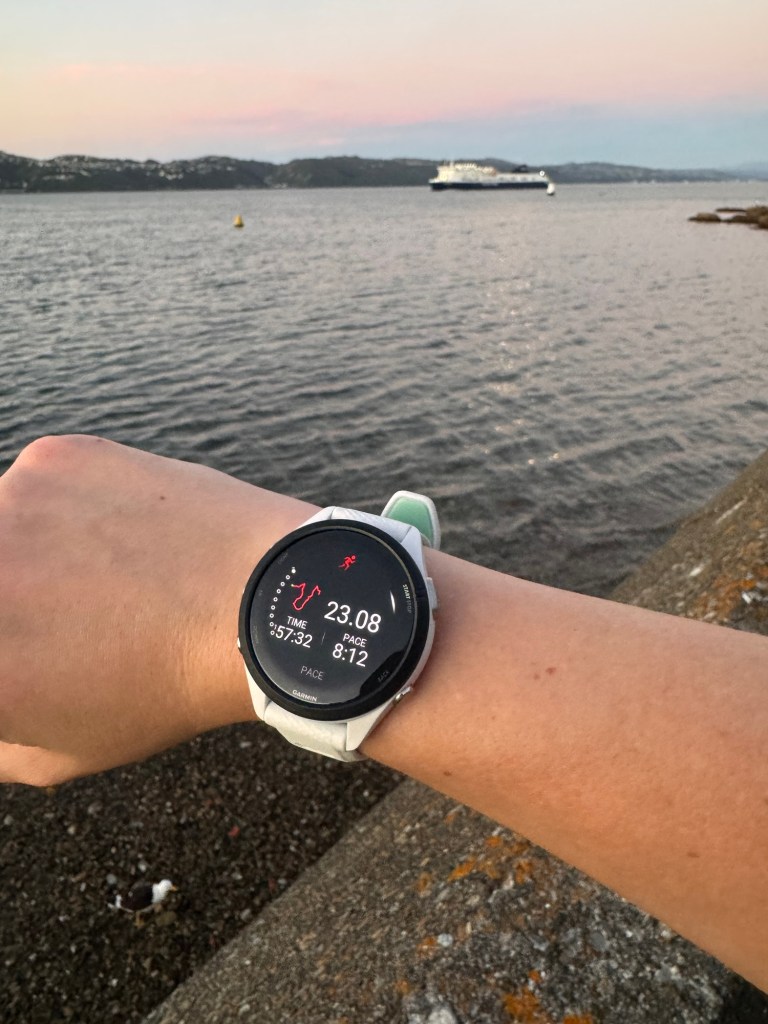
P.S. I took the watch for a spin this evening. Aside from getting completely thrown by the pace being in miles (still figuring out the settings) and adjusting to the feeling of something on my wrist, I actually enjoyed using it.
 ByFrancesca
Leave a comment